Main Campus
Hatfieldedit
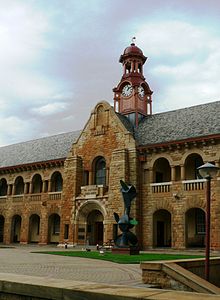
The university's main campus and central administration offices are situated in the suburb of Hatfield, Pretoria and houses six of the nine faculties. The campus, bordered by the suburb of Brooklyn to the south and Hatfield to the north, was built over 24 hectares (59 acres) and has more than 60 buildings of historical value.
Adjacent to the Hatfield Campus is the Hillcrest Campus, which contains the High Performance Centre and LC de Villiers Sports Grounds, which were developed on 76 hectares (190 acres). Adjacent to the sport grounds is the university's experimental farm, which is used to conduct field experiments for the Faculty of Natural and Agricultural Sciences. The campus is served by the Hatfield Gautrain station connecting Pretoria and Johannesburg. A university bus shuttle service operates between the Hatfield campus and the Groenkloof and Prinshof campuses, whilst a park-and-ride shuttle service operates between the Hatfield and Hillcrest campus.
Museumsedit
The university's art collection consists primarily of paintings, sculptures and graphic works by South African artists including the likes of Jacobus Hendrik Pierneef, Gregoire Boonzaier, William Kentridge and Sam Nhlengethwa. The collection also incorporates artworks by renowned international artists such as Max Pechstein, Käthe Kollwitz, Max Liebermann, George Grosz, Otto Mueller, Rembrandt van Rijn, Thomas Benton and Marc Chagall. The university's sculpture collection, the largest such collection in South Africa, contains sculptures by Sidney Kumalo, Maureen Quinn, Michael Teffo, Anton Smit and others.
The Old Arts Building was proclaimed a provincial heritage site in 1968 and houses the Van Tilburg Collection, Van Gybland-Oosterhoff Collection and Mapungubwe Collection. The Van Tilburg Collection is a permanent museum that exhibits 17th and 18th century furniture, paintings, Delft ceramics and other works of art, and includes the largest South African collection of Chinese ceramic objects, from the Qin (221–206 BC), Han (202 BC – AD 220), Tang (AD 618–906), Song (AD 960–1279), Ming (1368–1644) and Qing (1644–1912) dynasties.
What survives are the almost untouched remains of the palace sites and also the entire settlement area dependent upon them, as well as two earlier capital sites, the whole presenting an unrivalled picture of the development of social and political structures over some 400 years.
— UNESCO,
on the Mapungubwe World Heritage Site
The university is the custodian of the collection of artefacts found at the Mapungubwe National Park and World Heritage site and such display these artefacts in the Mapungubwe Museum. Gold ornaments, ivory, bone, ceramic-ware, clay figurines, trade beads, iron and copper artefacts are on permanent public display. The Van Gybland-Oosterhoff Collection is a ceramic collection, donated by Dr Horace Hugo Alexander van Gybland Oosterhoff and accepted by the university on 14 March 1939, is the largest collection of objects, publications, memorabilia and photographs of historical interest, relating to Dutch culture outside the Netherlands.
The Old Merensky Library houses the Edoardo Villa Museum. The Edoardo Villa Museum currently houses the largest collection of sculptures by the Italian artist Edoardo Villa and one South Africa's most renowned sculptors, who was mentored by Minotti at the Scuola D’Arte Andrea Fontoniby.
The Van Wouw Museum is the largest collection of bronze, marble and plaster sculptures by the famous pioneer South African sculptor, Anton van Wouw (1862–1945). Van Wouw, who is widely regarded as the founder of traditional sculpture in South Africa, created masterful artworks portraying Boer figures and the indigenous peoples of South Africa. Besides documents, photos, paintings and tools the exhibits are mainly bronze maquettes and casts of Van Wouw's sculptural work. The Van Wouw Museum is housed in Anton Van Wouw's last residence, a Dutch national monument.
Other minor art collections include the Christo Coetzee collection which was bequeathed to the university by the artist in 2001 and consists of more than 3000 objects, NPK Ceramics Collection, Hilgard Muller Collection, Mike Edwards Collection, Kruger Collection, Frans Esterhuizen Cartoon Collection, Hansie Visagie Puppet Collection, Friends of the Pretoria Art Association Art Collection, Baldinelli Trust Collection and Mimi Coertse Collection.
The University's Science, Engineering and Technology (SET) Discovery Centre, Sci-Enza, was officially launched in 1977. The Discovery Centre is an umbrella complex where young children, students and adults can explore the world of science, engineering and technology in a "play-as-you-learn" way. Activities at the Centre museum include: a digital planetarium; exploratorium; camera obscura; biological science exhibit; botanical garden and indigenous technology exhibit.
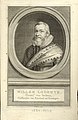
Willem Lodewijk, etching done by Jacobus Houbraken, published by Isaac Tirion, 1752. Forming part of the van Gybland-Oosterhoff Collection 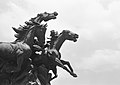
Equine sculpture by Danie de Jager, Lc de Villiers Sports grounds 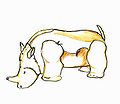
Illustration of a gold rhino statuete in the Mapungubwe Museum
Key placesedit
The main hall and site of ceremonies, the Aula, was designed by Karel Jooste and completed in 1958. The Aula was the first Opera House to be built in the capital and remained the major venue in the city until the State Theatre's completion in the early 1980s. The 1012-seat auditorium has played host to foreign dignitaries, presidents and local and international artists. The main music complex, comprising the 500-seat Musaion and 3000-seat Amphitheatre, was built between 1960–1964. The University Chapel, formally the Church of Saint Alfons Maria de Liguori, and the accompanying Monastery, was built in 1925 and was bought from the Catholic Church in 1980. Saint Alfons, who was canonised in 1839, was the founder of the order of Ligournians (or Redemptorists), an order founded in 1732 in Naples, Italy and dedicated to helping underprivileged communities.


Comments
Post a Comment